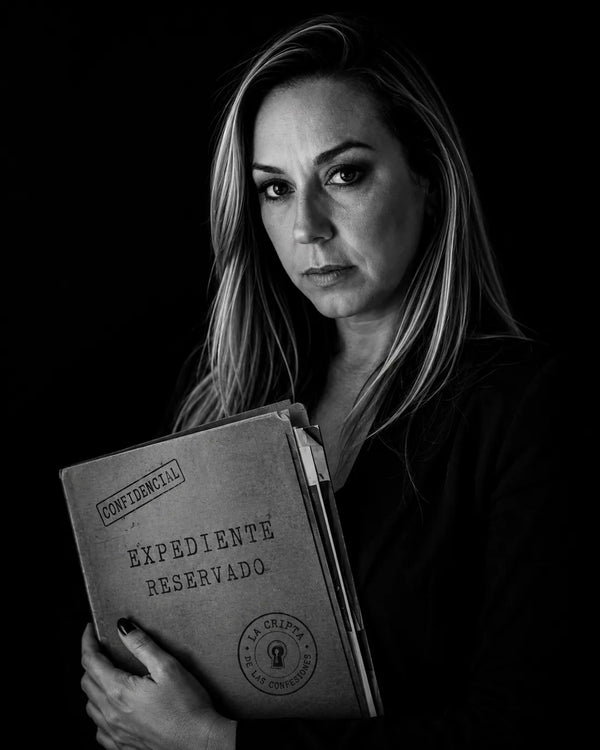
Sabadell (Barcelona, Spain), December 2001. Helena Jubany, a 27-year-old librarian, leaves home on a Friday morning. Forty-one hours later she is found dead in the inner courtyard of a building. Almost twenty-five years on, the case has reached the doors of a jury trial. This is the full timeline: what is known, what was investigated and what still has to be proven.
Forty-one hours
Some cases end with a verdict; others spend years, even decades, piling up questions. Helena Jubany's belongs to the second kind.
On Friday 30 November 2001, Helena left home for what seemed a routine errand. That afternoon she had a shift at the library. She never arrived. Her body was found on Sunday 2 December in the inner courtyard of a building in Sabadell.
Investigators quickly ruled out an accidental death. According to the forensic reconstruction published from the case file, Helena had been sedated and fell from a height while unconscious. The big question would take years to receive a judicial answer: who took her there, and why.
Who Helena was
Helena Jubany was born in 1974 in Mataró. She studied Journalism and did work placements at local media before turning to librarianship. In the last stretch of her life she worked as a librarian in Sentmenat and was studying Information Science.
In 2001 she was starting a new chapter. After a break-up she had moved to Sabadell to live on her own, and that city and that flat were part of the fresh start. A friend later said that the day before she disappeared she was happy.

To widen her circle, she joined the Natura group of the Unió Excursionista de Sabadell (UES), a local hiking club. There she met several of the people who would later appear in the investigation.
It is worth saying from the start: knowing someone, arguing with someone or being interested in someone proves nothing. Those details only matter once they are tested against evidence. And Helena's life (her work, her studies, her plans) cannot be reduced to her last hours.
The anonymous notes and the drinks

Months before the crime, Helena received two anonymous deliveries at her front door. They were not just letters: they came with drinks and with messages that set up a kind of game.
The first arrived on 17 September 2001: a bottle of horchata (a sweet tiger-nut drink), some pastries and a note inviting her to lunch and hinting that the senders knew her. Horchata was reportedly one of her favourite drinks, although knowing that does not, on its own, identify anyone.
The second arrived on 9 October: a peach juice and another note, which announced a third occasion when the mystery would be revealed and mentioned meeting on a UES outing.
Helena tried the juice and began to feel unwell; she became drowsy and needed help getting home. She decided to have it tested in a laboratory. The result: benzodiazepines, substances with a sedative effect.
That detail became disturbing when, after her death, benzodiazepines were also found in her body. The possible link between the drinks and the crime was investigated for years, but who wrote the notes and exactly how they relate to the killing have shifted from one expert report to the next. The notes are not a confession and do not automatically point to anyone.
Friday 30 November 2001
- MorningHelena looks at material for her studies on her computer, according to El País's reconstruction from the case file.
- 11:28She makes a phone call. Shortly afterwards she leaves home with her keys and handbag, but leaves her coat and scarf behind.
- 15:00Her shift at the Sentmenat library begins. Helena does not turn up.
- Saturday 1 DecemberHer father, Joan Jubany, goes to her flat because they had arranged to have lunch. She is not there.
- Sunday 2 DecemberHer body is found in the inner courtyard of a building on Calvet d’Estrella street.

Between leaving home and being found lies the great gap in the case: some forty-one hours that have never been fully reconstructed. Nobody knows for certain which door she went through, who she spoke to or who last saw her alive. We are not going to fill that gap with invented scenes.
The discovery

Helena's body was naked and had burns; some of her clothes were found on the building's roof terrace. According to information published later, the forensic reports pointed to a very high level of benzodiazepines.
The interpretation was that she was unconscious or in a coma when she fell from the rooftop, and that she died from the injuries caused by the fall. The investigation concluded that she was taken there and thrown alive, incapacitated by sedation. How she was moved, by whom and from exactly which spot are questions the court process still has to examine.
The essential point: it was never investigated as a voluntary disappearance. The forensic evidence pointed to a violent death involving other people.
The building and the first suspicions

Montserrat Careta, a fellow UES member, lived in the building where Helena was found. The investigation focused on the hiking club circle: Montse Careta and her partner at the time, Santiago Laiglesia; Xavier Jiménez, another member of the group; and Ana Echaguibel, with whom Helena had had a friendship that had cooled.
Each of these people came into the investigation for different reasons, and it is important not to mix them up. Living nearby, having argued or contradicting yourself in a statement can guide investigators, but it does not prove a murder.
Montserrat Careta
Investigators focused on the fact that she lived in the building where Helena was found, on the calls she made to Helena the day before she disappeared and on her contradictions about their relationship. On 14 February 2002 she was arrested and remanded in custody. She said she had spent that night with Laiglesia at his parents' home; according to reports on the case file, their first accounts did not fully match.
Montse Careta died in prison in May 2002, without ever being tried. She always maintained her innocence. The suspicions against her do not allow anyone to say she was guilty, and her death did not solve the case: it only prevented her explanations from being tested at trial.
Ana Echaguibel

A handwriting report from that period suggested she may have been involved in the anonymous notes. She was remanded in custody in March 2002 and held until July. She was eventually cleared.
Her story is a reminder of something essential: an investigation can mark a person's life even if it never ends in charges. And writing a note, even if it were proven, is not the same as committing a murder.
2005: the case is shelved

Santiago Laiglesia was investigated in the first phase and, according to reports on the case file, was named as a suspect again in September 2005. There was not enough evidence to bring him to trial and, in October 2005, the case was provisionally closed.
Closing a case is not a verdict: it means the proceedings stop at that stage for lack of evidence to continue. The Jubany family never stopped demanding an investigation, while time worked against them: fading memories, witnesses who were hard to trace and techniques that did not yet exist.
2020–2021: the reopening and the statute of limitations

In 2020 the case returned to public attention thanks to reports by TV3's Crims programme and to new testimonies. The case was reopened for new inquiries, driven by the persistence of the family and their lawyer, Benet Salellas.
In that phase, Xavier Jiménez took a central place: emails found on Helena's computer were reviewed and new expert reports on the anonymous notes were commissioned. On 1 December 2021, one day before the offence became time-barred for anyone not previously investigated, the court decided to name him as a suspect. The statute of limitations is not a declaration of innocence: it is a legal limit linked to the passage of time.
Meanwhile, the clothes Helena had been wearing were still in storage. And science had moved on a great deal since 2001.
The DNA on the jumper

Using modern techniques, specialists analysed the preserved biological traces. According to published reports, genetic material compatible with Santiago Laiglesia was found on Helena's jumper; other traces were also reported, whose origin has not been made public.
The result put him back at the centre of the case. On 28 November 2025 the Sabadell judge remanded him in custody. On 8 January 2026 the Barcelona Provincial Court released him after 41 days: it considered that the evidence against him was still solid but that, 25 years on, there was no flight risk to justify keeping him in prison.
Two questions need to be kept apart: whether a sample matches a person, and how that sample got onto the garment. The defence argues that it may have been an indirect transfer. That is a defence argument, not a proven fact. DNA does not solve a case on its own: it needs context and must be weighed alongside the rest of the evidence at trial.
The anonymous notes: a shifting piece
Authorship of the notes has been attributed differently over the years: first to people close to Helena; later, other expert reports pointed to Xavier Jiménez for part of the writing. In March 2026 it was reported that handwriting tests by Spain's National Police ruled out that Laiglesia wrote the two anonymous notes: one sample did not allow authorship to be established and the other did not match his handwriting.
That is why this case cannot be told as a simple story in which one person writes the notes and commits the crime. What has been published does not support it.
October 2026: the case goes to trial
In May 2026, the Public Prosecutor and the private prosecution (the Jubany family) filed their charges: they are seeking 26 years in prison for Laiglesia for murder and unlawful detention. They argue that the crime was not committed by one person alone, but that he took an active part. It is a requested sentence, not an imposed one.
On 16 October 2026, after a final hearing in Sabadell at which the defence asked for the case to be dismissed, the judge ordered that the case go to trial against Santiago Laiglesia, who will be tried by a jury at the Barcelona Provincial Court. In the same ruling she ordered the provisional dismissal of the case against Xavier Jiménez, because neither the Prosecutor nor the private prosecution asked for him to be tried; the prosecution has asked for him to testify as a witness.
As of this article, no trial date has been published and there is no judgment. Laiglesia remains presumed innocent, and that is not a formality: it is the difference between reporting on a case and anticipating a verdict.
What we know and what we don't

We know that Helena disappeared on 30 November 2001, that she was found on 2 December, that she had been sedated and that she died from the fall. That months earlier she received two anonymous deliveries and that the juice she tried contained benzodiazepines. That several people were investigated, that the case was shelved in 2005, reopened in 2020, and that the genetic analysis has led to a trial.
We don't know what happened in those forty-one hours, who sedated her or how she got to the rooftop; exactly how the anonymous notes relate to the crime; what the trial will explain about the DNA sample; whether there will be a clear motive or whether more than one person was involved.
And there is a human side that cannot be left out. Joan Jubany Itxart, Helena's father, attended every step of the proceedings for years and died in June 2026, aged 81, a few months before the trial was ordered. His son, Joan, is still asking for what the family has asked for since day one: the truth.